
Figure 1. Operational and business benefits of operating distributed data centers over an APN.
Photonics‑based connectivity allows multiple data centers to function as one, improves resilience during disruptions, and reduces cost and complexity by simplifying disaster‑recovery architectures.
Financial institutions are under pressure to modernize aging data-center architectures while maintaining reliability, security, and regulatory compliance. For many banks, space and power constraints make it difficult to scale their infrastructure within existing facilities, even as demand increases.The financial industry requires a fast, reliable, and sustainable method for connecting distributed data centers. This dilemma requires a new kind of wide-area network: the IOWN All‑Photonics Network (APN), which connects data centers via all-optical switching. An APN enables multiple geographically separated data centers to operate as though they were one, providing the bandwidth, low latency, and stability needed for real-time operation, even across distances.
To validate this approach, the IOWN Global Forum conducted a Financial Industry Proof of Concept (PoC) experiment. The PoC confirms two critical capabilities that show how an APN can unlock practical business value by supporting resilient, agile, and cost‑efficient financial infrastructure. This PoC focuses on two scenarios common to financial institutions:
- Intra‑regional Virtual Machine (VM) migration, i.e., moving VMs between different data centers within the same region
- Inter‑regional synchronous database replication, i.e., keeping two databases in sync across data centers that are far apart
Together, these scenarios illustrate how the network performs across distinct operating conditions.
Why Traditional Networks Limit Data Center Expansion
Many current data centers face power and space limitations. Banks’ central data centers are often already at physical and electrical capacity, making it difficult to deploy new services and reducing agility. Building or migrating to a new facility requires major capital investment and introduces operational risk. Until now, separating data centers has been impractical because traditional wide-area networks have been unable to provide LAN-equivalent bandwidth and latency between sites. Because synchronous replication isn’t feasible over long distances on conventional networks, banks rely on asynchronous replication, which has several major flaws. It introduces a data lag because updates are not written to the secondary data center simultaneously. Additionally, this method increases risk during outages, as data recorded at the primary site may not be available at the secondary site. And finally, it requires intermediate recovery systems to reconcile differences, making disaster-recovery workflows more complex and time-consuming.
The Solution: APN Enables Distributed Financial Infrastructure
The PoC report shows that synchronous database replication becomes practical with APN. This APN architecture allows distributed data‑center sites to operate as one unified environment. The experiment evaluated two scenarios that represent common challenges for financial institutions.
Use Case 1: Moving virtual machines between different data centers within the same region
In the first Use Case, the PoC evaluated Intra-Regional VM Migration across a distance of 100 kilometers. This scenario effectively represented the needs of banks. They need to move virtual machines between data center sites to increase resilience, agility, and cost optimization. Furthermore, they need the agility to shift workloads, expand capacity, or roll out new applications across data centers without disruption.
The PoC experiment demonstrated that data centers in the same region can share compute and network resources with minimal disruption.
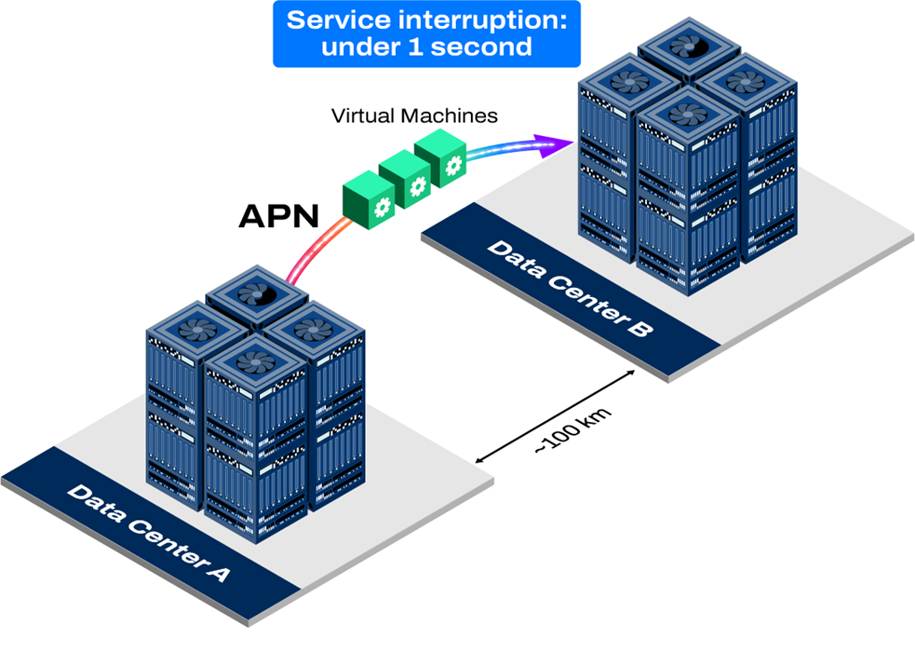
Figure 2. Intra‑regional virtual machine migration using the IOWN All‑Photonics Network.
Virtual machines are migrated between two data centers approximately 100 km apart with service interruption remaining under one second, enabling the sites to operate as a single environment.
With an APN, cloud infrastructures can be deployed across multiple sites in the same region. Subsequently, virtual machines can be migrated between these sites with minimal service disruption. In this way, the system functions as if all resources were part of a single operational environment.
The experiment produced technical evidence indicating that the scenario can move beyond a conceptual model toward early adoption use cases. Virtual machine migration downtime remained under 1 second under normal loads. The observed downtime aligns with banking-industry performance benchmarks and would be imperceptible to end users.
The experiment also showed a clear business impact. By enabling distributed infrastructure, photonics technology provides financial institutions with greater agility to roll out new applications. It also reduces the need for costly single-site expansions, improves operational efficiency across multiple data centers, and enhances operational continuity through regional distribution.
This scenario enables dynamic resource management, allowing banks to shift workloads or capacity between data centers as needed without rigid boundaries.
Use Case 2: Keeping two databases in sync across data centers that are far apart
The Proof of Concept also evaluated inter-regional synchronous database replication across a much longer distance of approximately 500 kilometers. This scenario represented banks’ need for real-time, zero-lag replication between a main data center and a distant backup site for disaster recovery.
The PoC demonstrated that an APN extends the distance over which synchronous replication can be performed while meeting industry standard performance requirements.
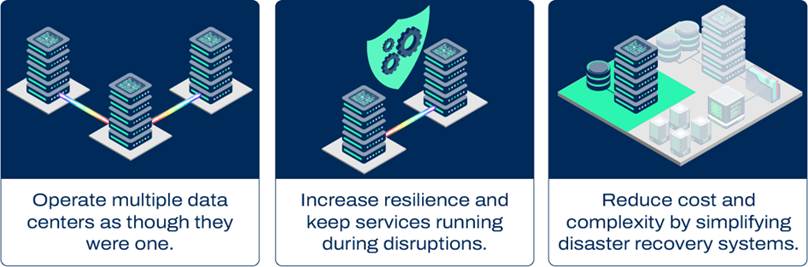
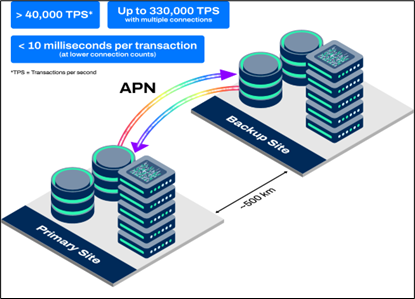
Figure 3. Inter‑regional synchronous database replication over the IOWN All‑Photonics Network.
An APN enables real‑time, zero‑lag replication between primary and backup data centers separated by approximately 500 km, sustaining high transaction throughput and sub‑10 millisecond latency under defined conditions.
The APN architecture enabled this outcome by providing the stability and throughput needed for synchronous replication over long distances. This has historically been considered impractical due to latency and performance degradation. But with an APN, it is possible to do synchronous database replication, even for two data centers separated by a 500-kilometer distance. Performance remained stable across distance, number of connections, and transaction volume.
The experiment resulted in key technical evidence:
- Sustained greater than 40,000 transactions per second (TPS) at ~500 km, which is sufficient for most national-level banking workloads
- With 300 or fewer concurrent connections, synchronous replication could be completed in less than 10 milliseconds per transaction, even across a long distance
Beyond the technical evidence, the business impact is also clear. In this scenario, an APN enabled real-time backup without data lag. It also dramatically simplified disaster-recovery architecture. With an APN, it is possible to bypass the redundant intermediate systems, therefore significantly improving data security and system efficiency.
Implications for the financial industry
For banks, the practical impact is that they can operate multiple data centers as one, unlocking new capacity without the constraints of traditional expansion. An APN also enhances resilience and continuity because long-distance synchronous replication reduces the risk of data loss and accelerates recovery. Financial institutions can use photonics-based technology to cut costs and simplify architectures with a reduced need for purpose-built backup systems and multi-stage recovery pipelines. Additionally, banks can future-proof their architectural flexibility. Distributed sites connected by an APN can accommodate evolving operational, regulatory, and security needs.
Enabling resilient, distributed financial infrastructure
Stable performance was previously unattainable over such distances. But an APN extends the distance over which synchronous replication can be performed while meeting industry-standard performance requirements.
With IOWN APN, you can operate multiple data centers as a single system.
The financial industry PoC demonstrates that APN can shape how banks design and operate their infrastructure, enabling distributed, resilient, real-time systems without the compromises traditionally associated with multi-site architectures. This foundation supports not only modernization, but long-term competitiveness in a rapidly evolving financial services ecosystem. Ultimately, these PoC results show how APN can help financial institutions build more resilient, efficient, and scalable operations as digital demands continue to grow.
Explore the full Financial Industry PoC report for technical details, or connect with an IOWN Global Forum Member at upcoming industry events to learn more about the progress of photonics‑based infrastructure.