By: Masahisa Kawashima, NTT, Technology WG Chair, the IOWN Global Forum
1. Technology Breakthrough: From Truck Distance to Flight Distance
Days of Truck-Distance Optical Transport
For decades, long-distance communication networks faced a fundamental limitation. The farther data traveled over optical fiber, the harder it became to maintain signal quality.
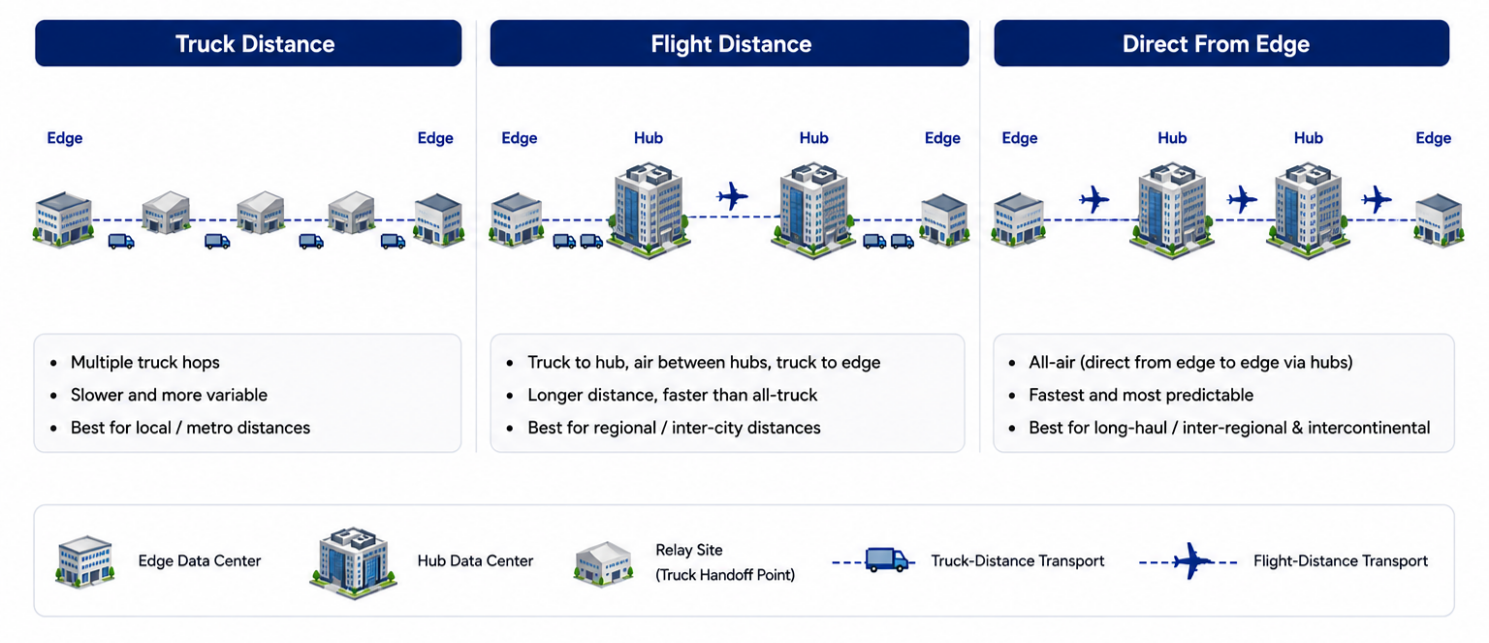
Earlier generations of optical transmission technology could move large amounts of data, but only over limited distances before the signal needed correction, amplification, or regeneration. Each optical transport segment was no longer than tens of kilometers. In this sense, optical transport at that time was analogous to truck transportation: capable of moving large volumes of data, but only across relatively short distances.
Around the 2010s, a major breakthrough emerged: coherent optical transmission.
Leap from Truck Distance to Flight Distance
Instead of relying purely on optical techniques to preserve signal quality, coherent systems introduced powerful digital signal processing (DSP) technologies capable of correcting transmission impairments electronically. This dramatically extended the distance that optical signals could travel without complex optical signal processing, e.g. dispersion compensation, or regeneration.
With coherent optical transmission, optical networks began to support data transport over distances of a few thousand miles, with capacities ranging from hundreds of gigabits per second to terabit-class and beyond. In other words, optical transport made a leap from truck-like distances to flight-like distances.
However, early coherent systems had an important limitation. Because they were large and expensive dedicated systems, coherent optical transport systems were deployed only at major hubs such as carrier backbone sites.
Long-distance backbone transport became dramatically more efficient — but the “last stretch” between access locations and hubs still depended on traditional hop-by-hop networking.
Direct Flight from the Edge
The next step in this evolution was coherent pluggables. Beginning in the late 2010s and accelerating in the early 2020s, compact coherent modules and IP-over-DWDM architectures became commercially available at scale.
With the emergence of compact coherent modules — installed directly into routers and switches — coherent transmission moved beyond specialized transport systems and became operationally practical across much broader parts of the network.
This fundamentally expanded where “flight distance” could begin. Now, coherent transport was no longer limited to backbone connections between large hubs. It became possible to extend long-distance optical connectivity much closer to users, enterprises, edge locations, and distributed compute sites.
2. Business Impact: Faster-to-Innovate Infrastructure with the Hub-and-Spoke Architecture
A key question follows: What happens when a network segment suddenly evolves from truck-like transportation distances to flight-like transportation distances? History provides a useful answer. In logistics, aviation did not simply improve transportation speed. It transformed the architecture of the entire logistics system.
Once long-distance air transport became practical and widely deployable, the hub-and-spoke model emerged and dramatically transformed logistics services by enabling:
- dramatic expansion of transport capacity — enabling much longer-distance and much higher-capacity logistics operations
- delivery speed — enabling overnight delivery
- real-time predictability, and manageability, visibility — enabling tracking systems
- operational efficiency through software-driven automation
- a flexible foundation for service innovation — accelerating the development of customized logistics services such as refrigerated delivery, integrated e-commerce fulfillment, and time-sensitive supply chain solutions
In other words, aviation transformed logistics from fragmented regional transport into an integrated, deterministic, and software-operable infrastructure platform.
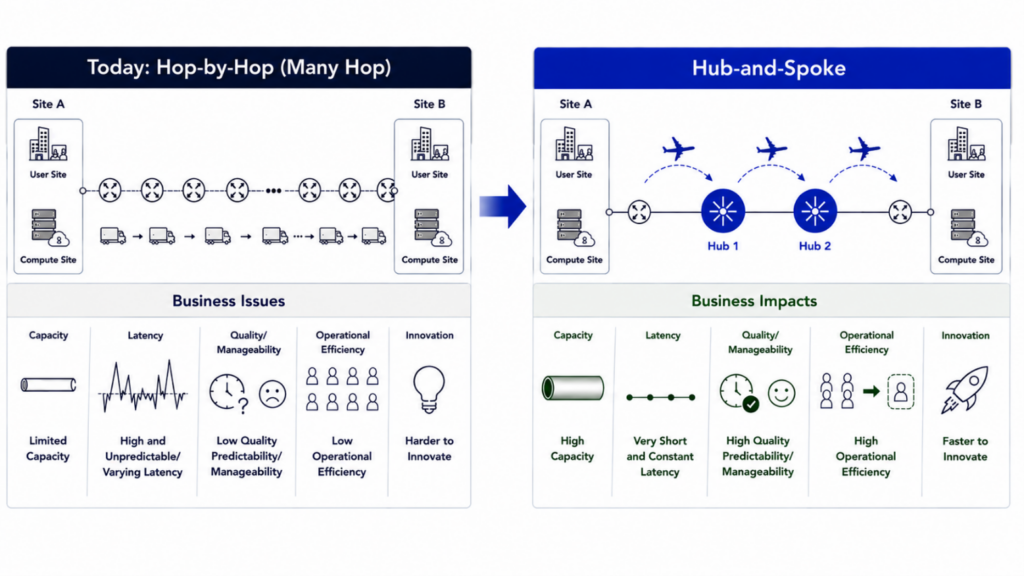
The same transformation is now becoming possible in communication infrastructure. With coherent pluggables, network operators will be able to provide advanced network services far more efficiently through cloud-based hubs. Coherent pluggables enable direct optical connectivity not only between hubs, but also between hubs and edge locations. This allows advanced network resources to be aggregated into hubs and operated using a cloud-style operation model. As a result, major advances become possible in:
- capacity — providing massive end-to-end optical bandwidth
- latency — approaching distance-based latency with minimal buffering delay
- QoS predictability, manageability, and visibility — enabling precise congestion avoidance and near jitter-free packet delivery
- operational efficiency through software-driven automation, including dynamic resource allocation and bandwidth-on-demand
- a flexible foundation for service innovation, supporting advanced capabilities such as integrated security functions and in-network computing, including in-network all-reduce operations. Ultimately, future hubs may also support emerging computing paradigms such as quantum computing.
In effect, coherent pluggables allow communication infrastructure to evolve from fragmented regional connectivity into an integrated, deterministic, software-operable, and innovation-ready infrastructure platform.
3. Why Now?
A natural question follows: Is this the right timing for such an infrastructure shift? The answer is yes — and the primary driver is the rapid expansion of AI across industries and society. This is exactly the moment when hub-and-spoke networking becomes strategically necessary.
Until now, communication infrastructure was primarily designed for human-to-human or server-to-human communication.
But the AI era introduces entirely new communication patterns such as AI-to-AI and AI-to-robot, introducing infrastructure requirements that conventional networking models struggle to meet:
Capacity
AI dramatically increases both data size and communication frequency. Large-scale training, inference, multimodal processing, and distributed AI coordination generate traffic volumes far beyond traditional enterprise applications.
At the same time, the number of communication endpoints will increase by orders of magnitude as AI agents, robots, autonomous systems, and edge AI devices proliferate.
Infrastructure designed for human-scale traffic patterns is unlikely to scale efficiently into this environment.
Latency
In many traditional applications, delays of hundreds of milliseconds were practically tolerable because human perception operates on relatively slow timescales.
AI systems and robotics operate on entirely different timescales. Even millisecond-order latency directly impacts performance and efficiency. As a result, low-latency, low-hop, deterministic transport becomes inevitable.
Energy Efficiency
As AI model sizes continue to increase, traffic volumes grow and endpoint counts may rise by orders of magnitude.
This means future infrastructure must improve energy efficiency dramatically — not incrementally.
Reducing unnecessary intermediate processing, regeneration, routing complexity, and inefficient traffic paths becomes increasingly important. Flatter hub-and-spoke architectures help reduce infrastructure overhead and improve overall transport efficiency.
QoS Manageability and Predictability
Traditional Internet networking assumes that packet loss is acceptable and can be corrected through retransmission mechanisms such as TCP/IP. This model worked well for human-centric applications. However, retransmission introduces multi-round-trip latency and unpredictability.
For AI infrastructure, message transfer should ideally complete within only the distance-dependent propagation delay — without retransmission.
Achieving this requires packet delivery with near-zero packet loss, near-zero jitter, and highly deterministic transport behavior.
Synchronization Capability
AI infrastructure increasingly depends on precise time synchronization across distributed systems. This is critical for several applications and infrastructure resource management use cases, such as digital twins with real-time telemetry, GPU cluster coordination, and precise congestion control.
Accurate timing synchronization and reliable inter-site state consistency become critical infrastructure requirements. The network is no longer simply transporting packets. It must become the foundation for precise inter-site synchronization across distributed compute systems.
Dynamic Consumption Capability
As owning AI compute infrastructure is a significant financial burden, many organizations will depend on GPU-as-a-Service models that allow AI compute resources to be used only when needed.
Naturally, organizations will seek to optimize costs through a pay-as-you-compute model.
Furthermore, organizations should be able to connect dynamically to available GPU sites based on resource availability and pricing.
This requires infrastructure that can dynamically control paths, quality, latency, and bandwidth allocation. By contrast, traditional networks can achieve either on-demand any-to-any communication with best-effort quality or inflexible, static communication with managed quality.
Hub-and-spoke architectures are much easier to achieve on-demand communication with managed quality because they reduce hop count, simplify topology, and improve operational controllability.
Taken together, these requirements point toward the same conclusion: The networking architecture of the pre-AI era does not match the operational structure of the AI era. To support AI-scale infrastructure efficiently, a new infrastructure transformation toward hub-and-spoke networking becomes necessary.
4. The IOWN Global Forum Approach to Hub and Optical Spoke Networking
Coherent pluggables have also helped create a broader open optical ecosystem, including industry activities around interoperable coherent interfaces, open line systems, and operational models such as those advanced by OIF, OpenZR+, and TIP. This ecosystem has made it increasingly practical to think of optical connectivity not as a closed transport system, but as an open, programmable, and interoperable infrastructure layer. Building on this broader industry movement, the IOWN Global Forum has been actively working to define an open architecture for hub-and-spoke networking.
The Forum’s next-generation architecture consists of two foundational layers:
- Open APN
- Deterministic Network (DN)
Open APN defines an open and disaggregated architecture for reconfigurable optical transport networks. It enables on-demand wavelength path provisioning for “flight-distance” optical transport across distributed infrastructure environments. In addition, the APN Domain Interoperability (ADI) Framework aims to enable optical peering across optical transport networks operated by multiple domains or operators. With this framework, Open APN sites belonging to different operators could be interconnected through direct optical flights.
Deterministic Network (DN) defines an open architecture for advanced packet forwarding in hub-and-spoke infrastructure. It enables on-demand virtual circuits between endpoints — including NIC-to-NIC connectivity — while achieving deterministic QoS characteristics such as near-zero packet loss and near-zero jitter.
Together, Open APN and DN aim to provide the foundational networking architecture required for AI-era infrastructure:
- high-capacity optical transport
- deterministic packet delivery
- dynamic resource orchestration
- distributed synchronization support
- software-operable infrastructure control
In this sense, the IOWN Global Forum is working not merely on faster networking technologies, but on a broader transformation toward AI-native infrastructure architecture.
5. Conclusion
The history of transportation shows that when transport distance makes a structural leap — from truck distance to flight distance — the impact extends far beyond speed improvement.
It changes the architecture of the entire system. That is exactly the transition now emerging in communication infrastructure.
Coherent optics first introduced “flight distance” into backbone networking. Coherent pluggables are now extending that capability toward the edge, making hub-and-spoke networking operationally practical across much broader parts of the infrastructure.
At the same time, the AI era is fundamentally changing infrastructure requirements:
- from human-scale latency to machine-scale latency
- from best-effort delivery to deterministic transport
- from static connectivity to dynamic resource orchestration
- from isolated systems to tightly synchronized distributed infrastructure
These requirements align naturally with flatter, lower-hop, highly manageable Hub-and-Spoke architectures.
This is why industry activities such as the IOWN Global Forum are becoming increasingly important.
Efforts such as Open APN and Deterministic Network (DN) represent early attempts to define the open architectural foundations required for AI-native infrastructure — combining deterministic packet transport, software-operable networking, and flight-distance optical connectivity into a unified operational model.
In this sense, coherent pluggables represent more than an incremental advance in optical networking. They are a key enabler of AI infrastructure, making broader deployment of deterministic, software-operable, flight-distance connectivity practical.